The quality of a discovery campaign is set before it starts. A clear brief gives the search something precise to aim at and something firm to stay inside. A vague one returns a shortlist that is technically correct and practically useless: hard enough, but made of an element your supply chain will not touch, or stable, but at a temperature your part never sees.
This guide walks through a good materials brief in the order your team should think about it. It applies whether your own team runs MS Lattice or Norck runs the campaign for you, where the first step, Define, is this: the properties you need, your requirements and your preferences.
Start with the job the material does
Write one or two sentences about what the material is for before you write any numbers. Not the family you expect or the composition you suspect, but the job: a coating for dry, high-speed machining; a magnet that keeps its strength inside a running motor; a sorbent that captures CO₂ from humid flue gas. The job decides which material domain serves you and which properties matter.
MS Lattice is built to start there. You describe the need, and it names the domain, states your targets in its own terms and tells you what is within reach, before anything is created. If no domain seems to fit, say what you need anyway, and MS Lattice tells you which domain serves it.
The best-known brief on MS Lattice’s record was one sentence: a coating for dry, high-speed machining, 28 GPa, 800 °C in air, under $30 a kilo. No starting structure, no family to begin from. (Ti,Al)N and (Cr,Al)N, the coatings the industry runs on today, came back in the top five.
Separate must-haves from nice-to-haves
The most important decision in a brief is which numbers are requirements and which are preferences. They are treated differently, and mixing them up is the most common way a brief goes wrong.
- Requirements are the limits your material must meet. MS Lattice holds them inside the search: a proposal that breaks one is turned away before a structure is built.
- Preferences are the properties you want pushed as far as they go. They are pushed on top of your requirements, never at a requirement’s expense.
- The budget is the third input: every campaign runs inside the budget you set.
A useful test: if a candidate missed this number by a little, would your team still want to see it? If not, it is a requirement. If you would want to see it and judge for yourself, it is a preference. The hardness a tool needs to survive the cut is a requirement; every gigapascal beyond that is a preference.
Be sparing with requirements. Each one narrows the search, so each should earn its place with a reason your team can state: the part fails without it, or the customer’s specification demands it.
Operating conditions and the elements you will not use
A property without its conditions is half a number. Coercivity at room temperature says little about a motor that runs hot, and a coating’s hardness matters at the temperature of the cutting edge, not on the bench. Name the temperature, the atmosphere, the voltage window, the field or the feed the material will see. MS Lattice’s domains are built around conditions like these: the magnets domain’s Automotive, 150 °C starting point aims for strength inside a running motor, and the MOF sorbents domain asks how humid the feed is.
Then list the elements you will not use, and say why: supply risk, as with heavy rare earths and cobalt; cost, as with platinum-group metals; toxicity, as with lead; or your customer’s rules. Several domains build this in, with starting points for cobalt-free cathodes, PGM-free catalysts, lead-free absorbers and rare-earth-free hydrides. Exclusions belong with the requirements: an element you will not use is not a preference to trade, it is a limit nothing may cross.
Cost limits and what you already know
Give two kinds of cost limit. The first is the material itself: a price per kilo, a cap on precious-metal content or on scarce elements. Most domains carry cost and supply risk as a target, so you can make it a requirement or push it as a preference. The second is the campaign. You see the price of every plan before you pay it, so decide in advance what a first round is worth to you.
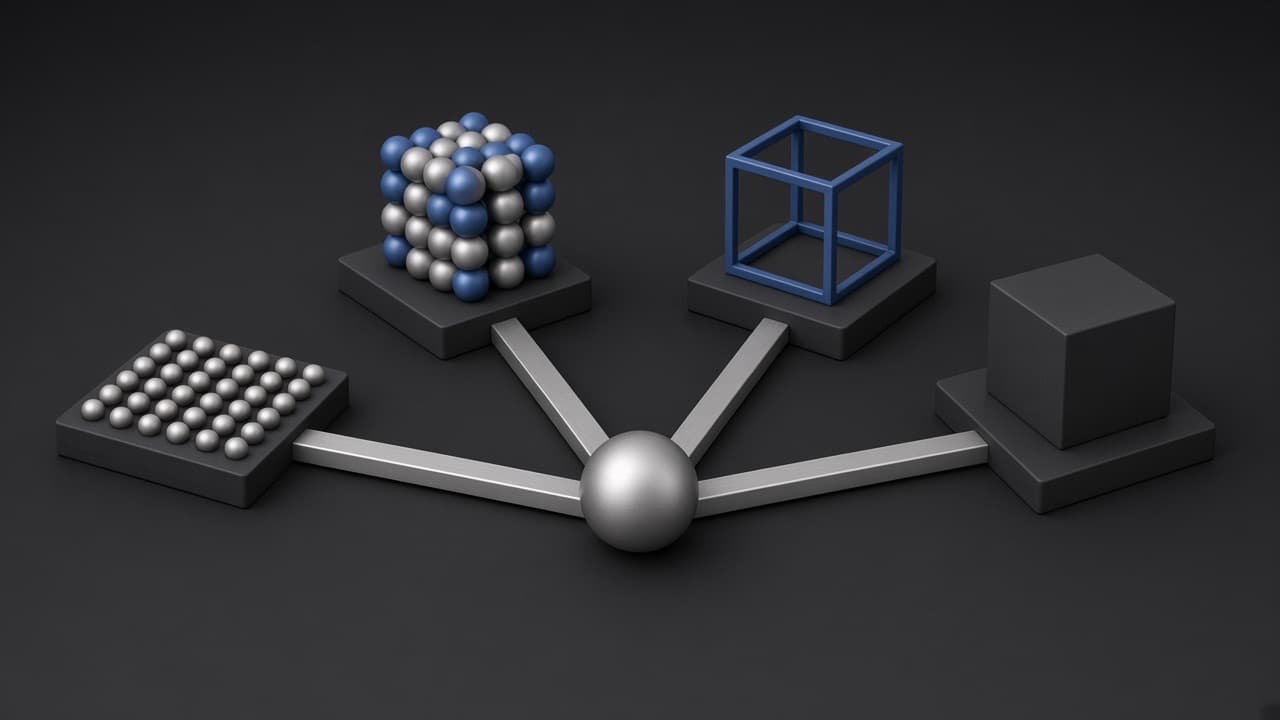
Then say what you already know. If you have a material that works and want it better, say so and supply the structure: Prototype-Guided Optimization searches around it and tracks every variant against the original. If you expect a family, such as layered oxides or MAX phases, say whether that is a hunch or a constraint. If you have nothing to start from, Open Discovery works from the target alone.
Worked example briefs
Each MS Lattice domain page states what a campaign in that domain asks you to specify. Here are four briefs built on those lists, written the way a team might send them.
A cathode with less cobalt
The battery-cathode domain asks for the ion and cell chemistry, the voltage and capacity you need, how fast it must charge, and how much cobalt and cost you will accept. A brief might read: a lithium-ion cathode for vehicles that go far on a charge, starting from the Long-range EV preset, with the cobalt limit as a requirement and lower cost pushed as a preference. You receive ranked layered, spinel, polyanion and open-framework candidates with estimated voltage, capacity, energy density, rate capability, stability and cost. Cycle life and performance in your cell format still have to be tested.
A motor magnet that runs hot
The magnets domain asks for the energy product or saturation you need, the operating temperature, and the elements you will not depend on. A brief might read: a hard magnet for a traction motor, holding its strength at 150 °C, with heavy rare earths excluded as a requirement and total rare-earth content pushed down as a preference. You receive ranked candidates with estimated energy product, coercivity at temperature, Curie temperature, and rare-earth and cobalt content. A grade still has to be made and measured before it goes into a motor.
A cutting-tool coating
The hard-coatings domain asks for the hardness, the working temperature, the substrate and the price per kilo. The one-sentence brief above is the pattern: dry, high-speed machining, 28 GPa, 800 °C in air, under $30 a kilo. Naming the substrate as well lets expansion match count. You receive ranked nitride, carbide, diboride and MAX-phase coatings with estimated hardness, mechanical stability, oxidation resistance, expansion match and cost. Coating hardness, adhesion and tool life depend on the deposition process and need cutting tests.
A sorbent for humid flue gas
The MOF sorbents domain asks for the gas and the conditions, such as CO₂ near room temperature or hydrogen at 77 K, how humid the feed is, and cost. A brief might read: CO₂ capture from humid flue gas, starting from the Carbon-capture sorbents preset, with water stability as a requirement and CO₂ uptake per volume pushed as a preference. You receive ranked frameworks with their structures and estimated uptake, water stability and cost. Uptake figures are screening estimates, not measured isotherms.
Common mistakes
- Naming a composition instead of a job. If you already know the answer, you are optimizing, not discovering: say so and supply the structure.
- Making every number a requirement. Keep requirements for what the part cannot do without.
- Quoting properties without conditions. A figure at room temperature says little about a part that runs at 800 °C.
- Leaving exclusions for the review. An element ruled out after the campaign wastes a round; ruled out in the brief, it never enters the search.
- Forgetting what the material sits against. Expansion match and stability against an anode only count if the brief names the substrate or the anode.
- Asking for properties the domain does not estimate. Fatigue in a structural alloy or cycle life in a cathode has to be tested, not screened.
- Treating the first round as the last. Keep the winner, tighten the target and run again.
From brief to campaign
Once the brief is written, MS Lattice turns it into a plan and checks it before launch: a plan that cannot run is refused with the reason, and the estimated cost is shown up front. You can follow the campaign round by round, stop it at any time, and read back ranked candidates, each scored against every target you set, with the record of every check and a standard CIF structure file. Change a requirement, and the next campaign follows it at once.
The brief can also come from your AI agent: it states the need over MCP, MS Lattice names the domain that serves it, and the agent builds the plan and sees the price first. With Norck, the strongest candidates are selected against your requirements and target properties before they are synthesized and tested.
Questions teams ask
How many requirements should a brief have?
As few as the job allows. Keep requirements for the limits the part cannot do without and put everything else in preferences, which are pushed as far as they go without costing a requirement.
Can we change the brief between rounds?
Yes. Change a requirement, and the next campaign follows it at once. Most programs tighten the target as they learn: keep the winner, tighten the target, run again.
What if our material does not fit a domain?
Say what you need, and MS Lattice tells you which domain serves it. For ceramic–polymer composites, the solid-electrolyte domain searches for the ceramic filler.
Do we need numbers for everything?
No. Every domain offers goal presets, proven starting points you can use as they are or adjust with your own numbers, in your units.


MatterSpace’s first domain engine
MatterSpace built MS Lattice for the scientists and engineers who discover and design new materials, starting from the properties their product needs.