Clean chemistry runs on materials
Most routes to cleaner fuels and chemicals come down to a few material problems. Splitting water into hydrogen needs catalysts on both electrodes and a membrane or solid electrolyte between them. Turning hydrogen back into power in a fuel cell needs a catalyst for the slow oxygen reaction at the cathode. Capturing CO₂ needs a sorbent that holds it and lets it go again without too much energy, and converting CO₂ into fuels needs a surface that makes the product you want rather than a mixture. Storing hydrogen needs something denser than a gas cylinder.
Cost runs through all of it. The most active catalysts for water electrolysis and fuel cells rely on platinum and iridium. Iridium in particular is mined in small amounts, mostly as a by-product of platinum, so a large build-out of acidic water electrolysis cannot scale up today’s anode loadings. Getting the same activity from less precious metal, or from none, is a central goal of the field.
MS Lattice covers this chain with four domains: catalysis, solid electrolytes, MOF sorbents and hydrogen storage. Each is its own campaign, with its own targets and its own stated limits.
Catalysis: activity per gram of precious metal
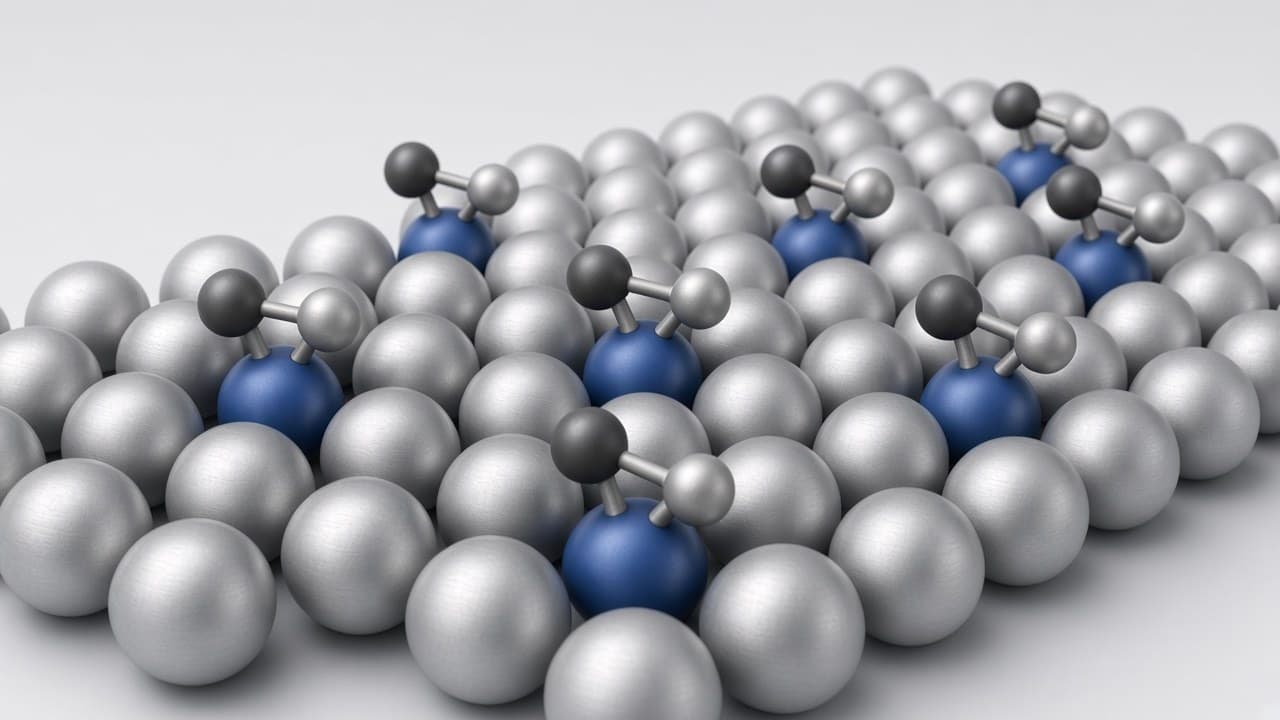
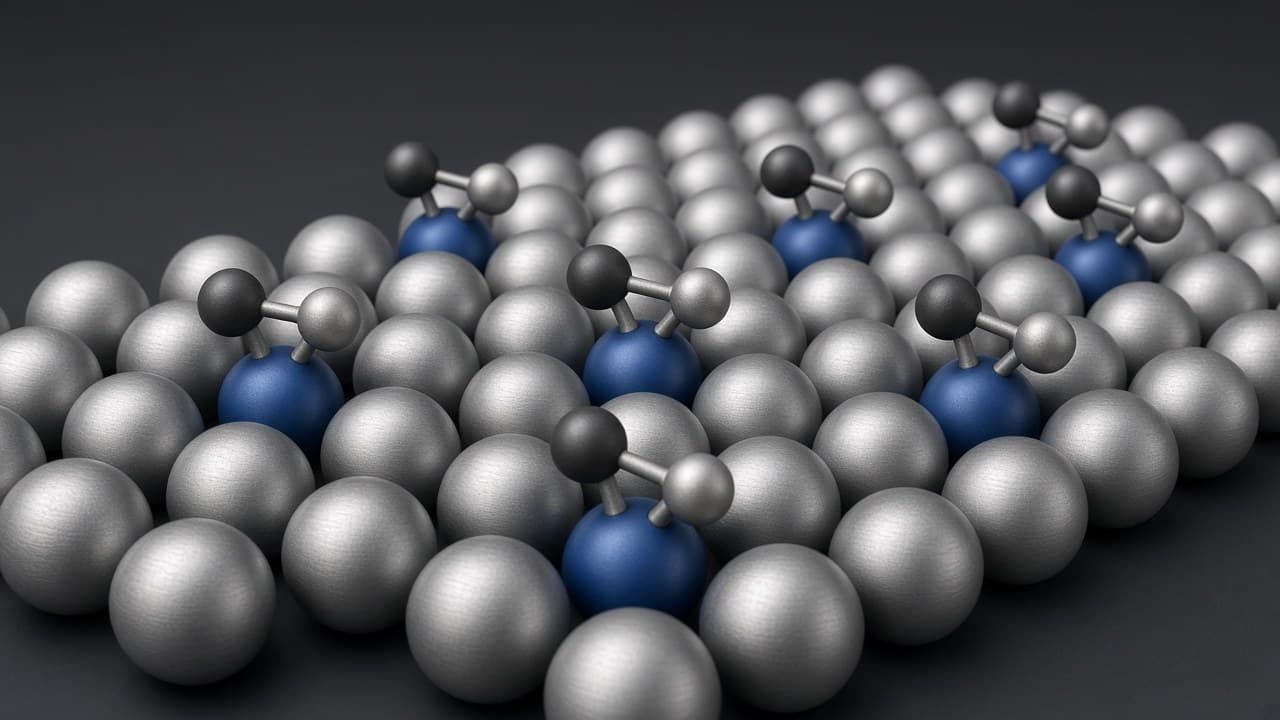
The catalysis domain runs from single active sites to whole surfaces. It searches six groups: single-atom alloys, one active atom placed exactly where it works; alloy surfaces, several metals on one working surface; oxide-supported catalysts, metal sites anchored on oxide supports; acid OER anodes, for oxygen evolution in acidic water electrolysis; ORR alloys, with platinum only where it counts; and CO₂ reduction surfaces, for turning CO₂ into fuels and chemicals.
Each group answers a known problem. Single-atom alloys aim to get the activity of a precious metal from a few isolated atoms in a cheaper host. Alloying platinum with other metals is an established way to raise its activity for oxygen reduction, so less of it is needed per fuel cell. CO₂ reduction is as much about selectivity as activity, because a surface that makes a mix of products leaves a separation problem behind.
A campaign can aim for activity on your reaction, stability in operation, precious-metal content and cost. Four starting points cover common work: Hydrogen evolution, hydrogen from water; CO₂ reduction; Methane cracking, methane into hydrogen and solid carbon, a route that makes hydrogen without releasing CO₂ from the reaction itself; and PGM-free, activity without platinum-group metals. You specify the reaction, the conditions it runs in, how much precious metal you will spend and any elements you will not use.
Solid electrolytes: the electrolyzer and fuel-cell side
Solid electrolytes are best known for solid-state batteries, but they are also central to high-temperature electrolyzers and fuel cells. Solid oxide cells move oxide ions through a dense ceramic, and protonic ceramic cells move protons, usually at lower temperatures. Both convert efficiently when the electrolyte conducts well, stays stable against the gases and electrodes on each side and can be made dense and thin.
The solid-electrolytes domain includes oxide-ion conductors, for solid oxide cells, and proton conductors, for protonic ceramic cells, alongside the garnet, NASICON, sulfide, halide and composite groups used in batteries. A campaign can aim for ionic conductivity, the electrochemical stability window, stability against the anode, processability and cost. Processability deserves weight in this setting: many good proton conductors are hard to sinter dense, and their grain boundaries can dominate the cell’s resistance.
MOF sorbents: capturing and separating gas
Metal–organic frameworks are crystals built from metal nodes and organic linkers, with pores that can be tuned to a gas. Their promise for carbon capture is high uptake with less energy to regenerate than liquid amines. Their weakness is water: flue gas and air are humid, water competes with CO₂ for the same sites, and some frameworks lose their structure when wet.
The domain searches three series. The IRMOF series, MOF-5 and its relatives, suits dry feeds. The UiO series, zirconium and hafnium frameworks, stands up to water. Zeolitic imidazolate frameworks, ZIF-8 and its relatives, sieve gases by size. A campaign can aim for CO₂ uptake, H₂ uptake or surface area, CO₂ uptake per volume, porosity, water stability, and cost and supply risk. Uptake per volume matters because a capture column has a fixed size.
Five starting points cover the main uses: Carbon-capture sorbents, water-stable frameworks for humid flue gas and air; Cryogenic hydrogen storage, high-surface IRMOFs for a 77 K tank; Kinetic CO₂/CH₄ sieving, ZIF windows that let CO₂ through and hold methane back; Water-stable sorbents; and Low-cost sorbents.
Hydrogen storage: holding hydrogen in a solid
Hydrogen is light but bulky. Compressed gas needs heavy tanks at high pressure, and liquid hydrogen needs cryogenic temperatures. Metal hydrides store hydrogen inside a crystal at modest pressure and high density by volume. They are heavy, so they suit stationary storage and fuel-cell supply where weight matters less than space and simplicity.
The hydrogen-storage domain searches AB₅ hydrides, LaNi₅ and its substitutions tuned to room temperature; AB₂ Laves hydrides, the titanium–zirconium–manganese class; AB hydrides, TiFe and its substitutions, low in cost; bcc solid-solution dihydrides, vanadium and titanium alloys with two hydrogens per metal atom; and magnesium hydrides, with the highest capacity but held back by stability, since magnesium hydride gives hydrogen back only when hot. A campaign can aim for release near room temperature, gravimetric and volumetric capacity, metal cost and supply risk. Its Rare-earth-free hydrides starting point keeps every family outside the lanthanum supply chain.
Writing briefs across the hydrogen chain
A program that spans production, use and capture runs several campaigns. Five examples, each with the domain that serves it:
- Make the hydrogenIn catalysis, start from Hydrogen evolution, or brief an acid OER anode with a cap on iridium. If the feed is natural gas, Methane cracking is the starting point.
- Conduct the ionsIn solid electrolytes, aim at proton or oxide-ion conductors for a ceramic electrolyzer or fuel cell, with processability in the requirements.
- Store itIn hydrogen storage, require release near room temperature and leave out rare earths if your supply chain demands it.
- Turn it back into powerIn catalysis, rank ORR alloys with a limit on platinum content and stability in operation as a requirement.
- Capture and convert the carbonIn MOF sorbents, start from Carbon-capture sorbents for a humid feed. In catalysis, start from CO₂ reduction for the conversion step.
Keep the shared limits consistent. If a metal is off the table for your program, name it in every brief, and set cost in each domain’s own terms.
What you receive, and what the reactor decides
A catalysis campaign returns ranked single-atom-alloy, alloy-surface, oxide-supported and electrocatalyst candidates, with estimated activity on your reaction, stability in operation, precious-metal content and cost. The MOF domain returns frameworks with their structures, each with its computed density, porosity, geometric surface area and pore sizes, and its estimated CO₂ and H₂ uptake, water stability and cost. The hydrogen-storage domain returns hydrides with estimated release temperature and pressure, capacity by weight and by volume, stability, metal cost and supply risk. Every candidate carries its uncertainty, the checks it passed and a structure file.
- Particle size and support: a catalyst’s surface, dispersion and the support under it change what it does.
- Reactor conditions: temperature, pressure, pH, current density and impurities in the feed decide activity and selectivity.
- Cycling: start-stop operation dissolves catalysts, hydrides crack and slow over many cycles, and sorbents must survive repeated regeneration.
None of these four domains carries a proof of its own on the record, so treat the rankings as screening for your lab. The economics on the record are what change the plan: a screen this cheap lets you look widely before committing the expensive part, the catalyst tests and reactor hours.
- ≈ $0.003of compute per candidate in the blind benchmark
- ≈ 30 sof compute per candidate in the same run
If you want the testing done for you, Norck runs MS Lattice and offers the work as a service in four scopes: Discovery; Discovery + Validation, with candidates synthesized and physically tested; Discovery + Validation + Production, a validated material, produced; and End to end, to your final, manufactured parts.
Questions teams ask
Does MS Lattice predict selectivity for CO₂ reduction?
It estimates activity on your reaction, stability, precious-metal content and cost for well-defined surfaces. Selectivity depends on particle size, support and reactor conditions, and has to be tested.
Can we search for catalysts with no platinum-group metals?
Yes. Start from the PGM-free preset, or set the metals you will not use in your own brief.
Are the MOF uptake figures isotherms?
No. They are screening estimates, and the surface area is geometric. Isotherms, working capacity and selectivity are measured in the lab.
Which hydrides suit a stationary store?
The Low-cost TiFe and Laves hydrides starting point is built for it, with iron- and manganese-based hydrides. Rare-earth-free hydrides is the option if lanthanum is a concern.


MatterSpace’s first domain engine
MatterSpace built MS Lattice for the scientists and engineers who discover and design new materials, starting from the properties their product needs.