The hottest parts of a machine are where materials decide what the machine can do. A gas turbine gains efficiency with every degree it can add at the turbine inlet. A hypersonic vehicle is limited by what its leading edges and nozzles survive. A furnace, a glass line or a heat-treatment shop runs only as hot as its hardware and heating elements allow. In all of them, the material sets the ceiling.
This post is for engineers and R&D leads in aerospace, defense, space, power generation and high-temperature industry. It covers the pressures a hot-section material faces, what each of the five MS Lattice domains that serve the hot section can aim for, what the record shows on ultra-high-temperature ceramics, and where the screen stops and the rig and the engine take over.
Four pressures at once
A hot-section material is never judged on one property. It has to clear four pressures together, and improving one usually costs another.
- Temperature. In a modern turbine the gas reaching the first blades is hotter than the melting point of the nickel superalloy they are made of. The blades survive on internal cooling air and a ceramic thermal barrier, and every bit of cooling air the engine spends is efficiency lost.
- Oxidation. At these temperatures, air attacks almost every metal. The materials that last are the ones that grow a thin, slow, adherent oxide scale, usually alumina or silica, and keep it attached through every heating and cooling cycle.
- Creep. Under load at high temperature, metals slowly stretch. A turbine blade spinning at speed for thousands of hours has to hold its shape, which is why creep resistance governs alloy choice in rotating parts.
- Weight. Every kilogram in a rotating part adds load to the disc that holds it, and every kilogram in flight costs fuel or payload. Refractory metals survive heat but are dense; ceramics and composites are lighter but brittle.
Hypersonic flight sharpens all four. A sharp leading edge is good for aerodynamics and bad for heating, because heat concentrates at a small radius. Diborides of zirconium and hafnium, often with silicon carbide added for oxidation resistance, and carbides of hafnium and tantalum, among the highest-melting materials known, are the usual candidates. Rocket nozzle throats add erosion by hot, fast gas.
Five domains, one stack
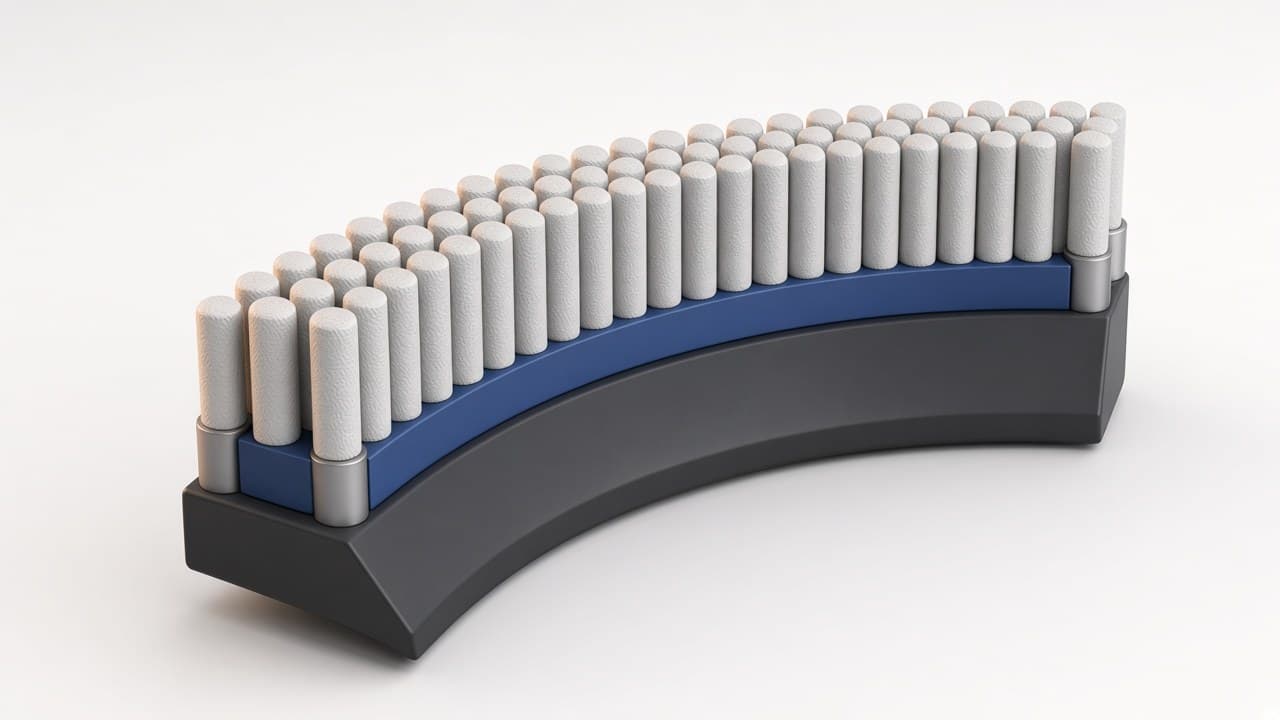
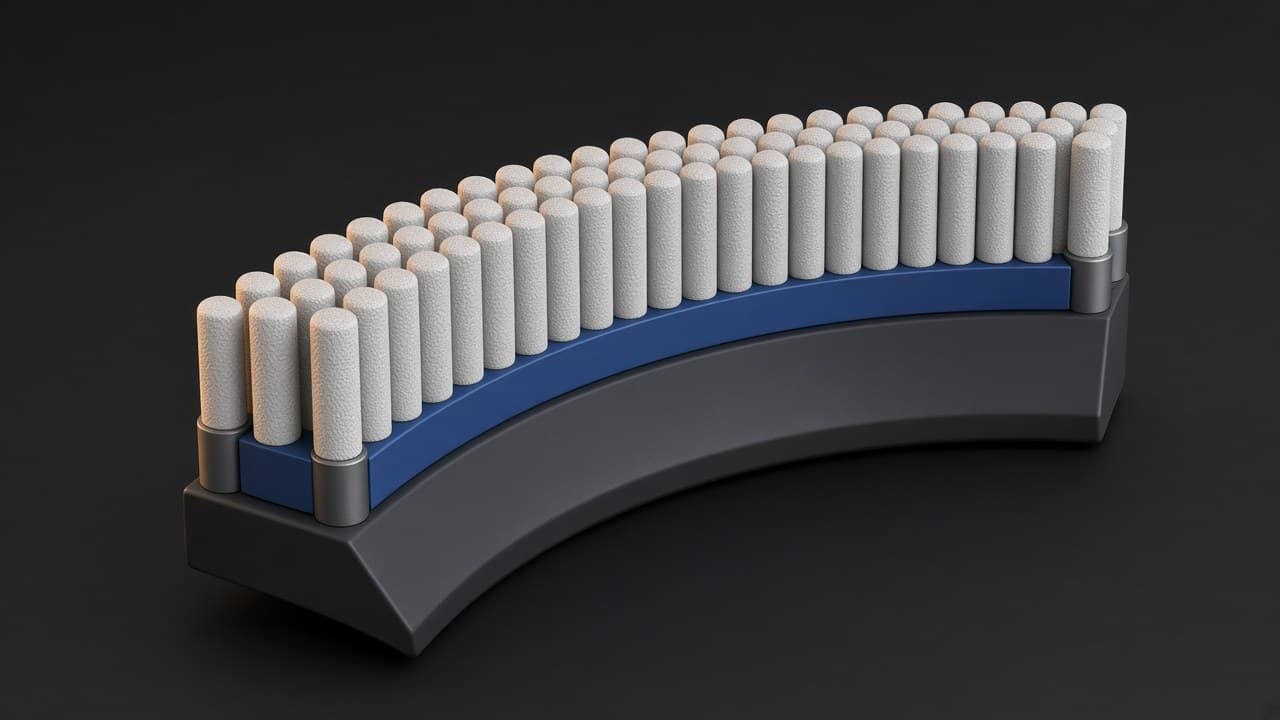
A turbine blade is a stack: a superalloy part, a bond coat that grows a protective oxide, and a ceramic top coat that insulates. Ceramic-matrix composite parts need a different coating again. MS Lattice covers the layers with separate domains, each with its own targets, groups and starting points.
Thermal barrier coatings
Yttria-stabilized zirconia has been the industry’s top coat for decades. At higher temperatures it sinters, which raises its conductivity and stiffness, and its phases change. The domain aims for low thermal conductivity, thermal-expansion match, toughness, sintering resistance and phase stability at temperature, across stabilized zirconia, rare-earth zirconates for lower conductivity, high-entropy oxides for stronger insulation and environmental barrier coatings for ceramic-matrix composites, which need protection from water vapor in combustion gas. Presets include Ultra-low thermal conductivity, Next-generation turbines and EBC for CMC. You specify the surface temperature, the substrate it must match in expansion, and the toughness and life you need.
Oxidation-resistant coatings
Under the top coat, the bond coat grows the alumina scale that holds the system together. This domain aims for a protective service ceiling, oxide stability, a protective scale, slow scale growth, scale–alloy expansion match and adherence, across β-NiAl and platinum-modified aluminides, γ′-Ni₃Al aluminides, MCrAlY bond coats, FeCrAl ferritic alloys and disilicides, the silica formers for the highest temperatures. Presets include Alumina-forming bond coats, Platinum-modified aluminides and Ultra-high-temperature silicides.
Ultra-high-temperature ceramics
For leading edges, nozzles and thermal protection, the domain aims for melting point, oxidation resistance, thermal-shock resistance, thermal conductivity, density, and cost and supply, across rock-salt carbides, diboride composites, high-entropy carbides and high-entropy diborides. Its presets include Leading-edge composites, Highest-melting carbides and Rocket nozzle inserts.
Structural alloys and high-entropy alloys
For the metal behind the coatings, the structural-alloys domain screens titanium and dilute refractory solid solutions of tungsten, molybdenum, niobium and tantalum for nozzle liners, furnace and rocket-engine hardware, on specific stiffness, stability, low density and an indicative melting point. The high-entropy-alloys domain searches compositions of four to six principal elements, including refractory alloys that are strong where it is hottest, on yield strength, toughness, phase stability, density and cost; its Aerospace preset aims for strength at temperature, at low weight.
Creep is not on the list of what these domains estimate, and the structural-alloys domain says so outright. Phase stability at temperature is a precondition for creep resistance, not a measure of it. Plan to measure creep on made material.
Proven blind on ultra-high-temperature ceramics
The most direct proof on MS Lattice’s record sits in this field. In a blind benchmark on ultra-high-temperature ceramics, the two target materials stayed sealed while MS Lattice searched and ranked. They steered nothing and ranked nothing. When the candidates were frozen and the targets revealed, both had been found, down to the arrangement of their atoms.
- 2 of 2sealed targets found
- 64candidates, in two rounds
- 32 minof compute
- < $0.20for the whole run
Every match level passed, for both targets. Re-run end to end, 9 of 9 checks passed, and a leak check confirmed the match was found, not remembered. Separately, in Guided Rediscovery steered towards zirconium diboride, all 14 scored candidates matched it at every level, in a campaign of about three minutes, the closest within 0.0008 Å.
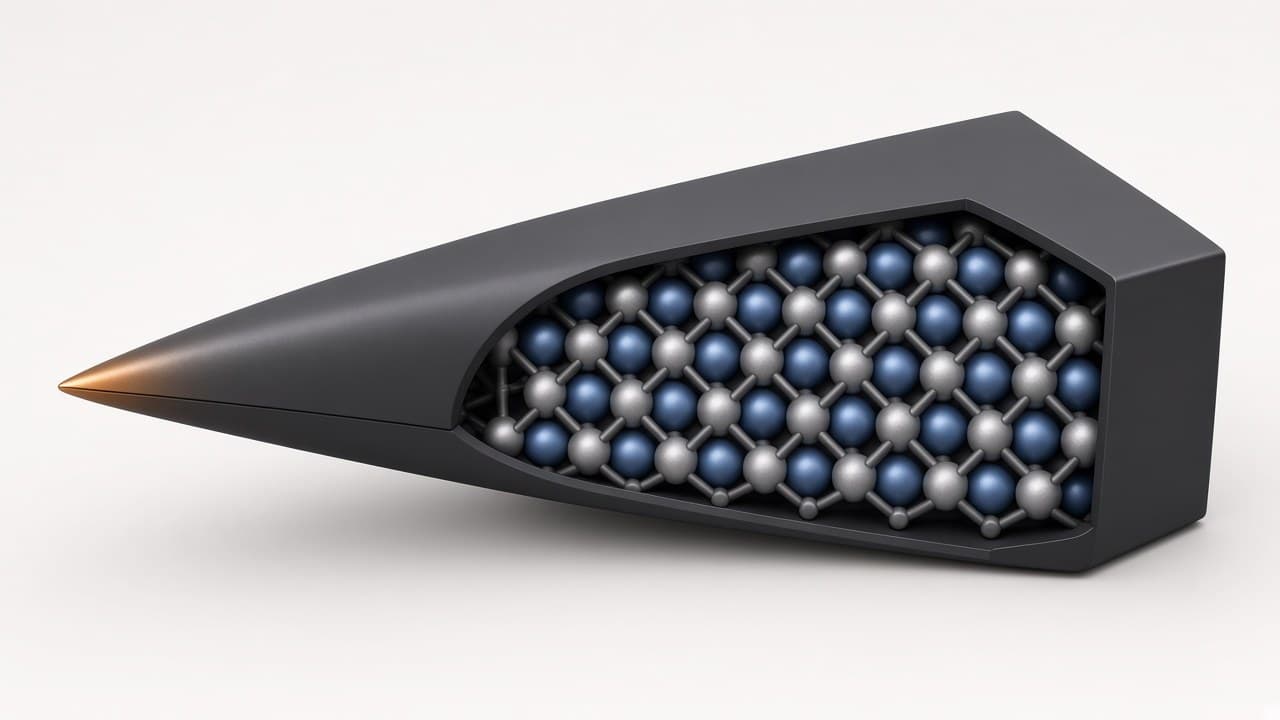
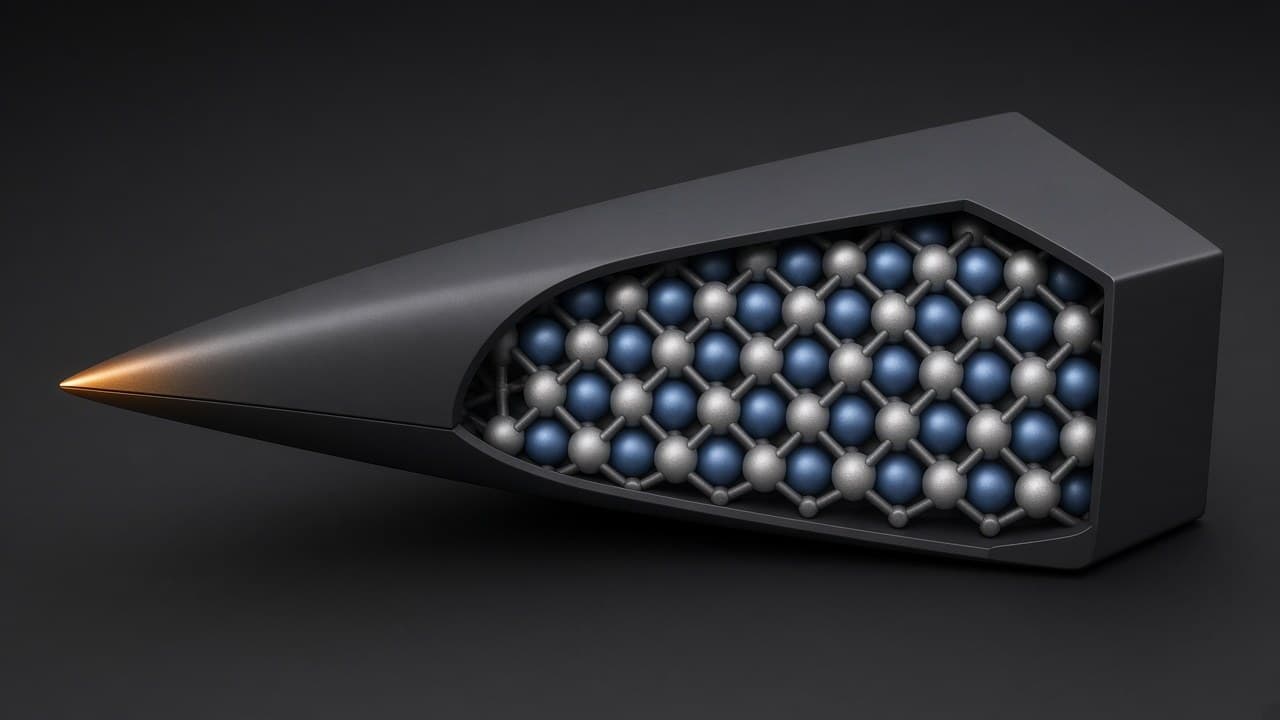
For a hypersonics or propulsion team, the meaning is specific. Every property estimate starts from a crystal structure, and the benchmark shows the engine reaching the right structures in the very family your hottest parts are made of, without being shown the answer. It is also a test you can run yourself: seal targets of your own choosing and see whether they come back before you trust a campaign with what your lab has not found yet.
The record holds no campaign result for thermal barriers, bond coats or the two alloy domains. It does hold checks on two of their chemistries: Ni₃Al, the strengthening phase of nickel superalloys, was one of four compounds held out of everything MS Lattice starts from and rebuilt to within a few hundredths of an ångström, and MS Lattice’s first-principles stability check called the disilicide MoSi₂ stable and a deliberately wrong arrangement of it unstable.
Starting from what you fly today
Most hot-section programs improve a material they already trust rather than replace it. Prototype-Guided Optimization is built for that: give it your stabilized zirconia, your bond coat or your alloy and what to improve, and it searches around the structure and tracks every variant against the original. Open Discovery suits a target with no starting structure, such as a new environmental barrier for a composite part. Each campaign shows its price before it launches, and each candidate comes ranked, with the record of every check and a CIF structure file. First-principles verification of stability, elastic constants and phonons is on call for the candidates you choose.
Where the screen stops
A hot-section material lives or dies as part of a system, and much of that system sits outside any screen. Coating architecture, the thickness, porosity and microstructure of each layer and how they are built up, is set by the deposition process. Processing decides whether a ceramic reaches full density and how an alloy’s grains form. And what a part does in an engine is learned only on rigs and in engines.
- Shortlist by layerRun the domain that fits each layer, with your temperature, substrate and weight limits held inside the search.
- Make dense samplesHot-press ceramics, melt alloy buttons and prepare powders, then confirm each phase against its structure file.
- Test in the furnaceMeasure conductivity, cyclic oxidation, scale growth, phase stability after long exposure and, for alloys, creep.
- Build the systemDeposit the full coating stack on real substrates and run burner-rig, arc-jet or molten-deposit tests.
- Hand over to engine testingEngine testing, and the decision to fly or run a material, belong to the engine maker, the operator and their regulators.
Aerospace and aviation, space technologies, defense and energy are among the fields MatterSpace builds for. If you want help past the screen, Norck runs MS Lattice, then synthesizes, validates and manufactures the winner, within the scope you choose: Discovery, Discovery + Validation, Discovery + Validation + Production, or end to end, to your finished parts.
Questions teams ask
Can MS Lattice design a whole thermal barrier coating system?
It screens the materials for each layer: the top coat, the bond coat and the alloy beneath. The architecture of the system, its deposition and its cycling life are set and tested outside the screen.
Does it predict creep?
No. Creep, fatigue and strength at temperature are not predicted for structural alloys and have to be measured on made material.
What did the blind benchmark prove?
That with two ultra-high-temperature ceramics sealed away, MS Lattice found both, down to the arrangement of their atoms, among 64 candidates, in about 32 minutes, for under $0.20. It does not measure how they perform in a flow.
Which domain fits a bond coat?
Oxidation-resistant coatings. Its Alumina-forming bond coats and Platinum-modified aluminides presets are written for the layer under a thermal barrier.


MatterSpace’s first domain engine
MatterSpace built MS Lattice for the scientists and engineers who discover and design new materials, starting from the properties their product needs.