

Hydrogen storage.
Hydrides that let go near room temperature.
A hydrogen storage campaign finds metal hydrides that hold the capacity you need and give hydrogen back near the temperature your system runs at.
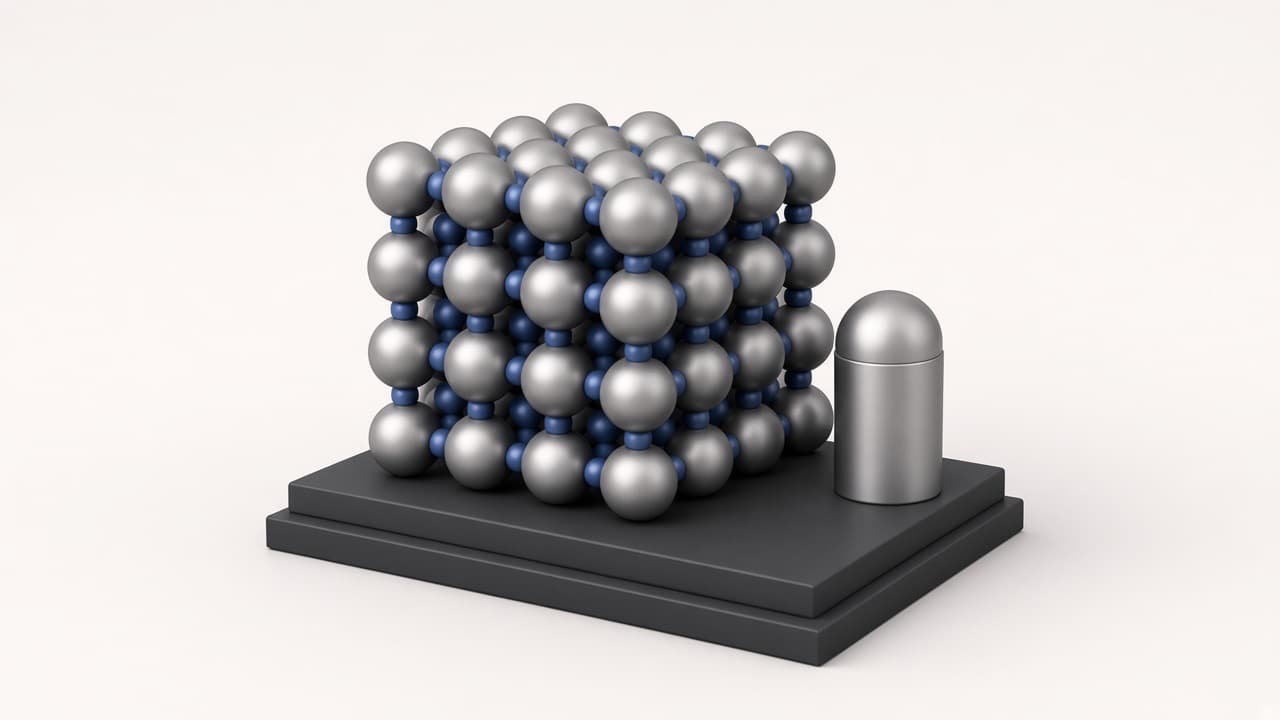
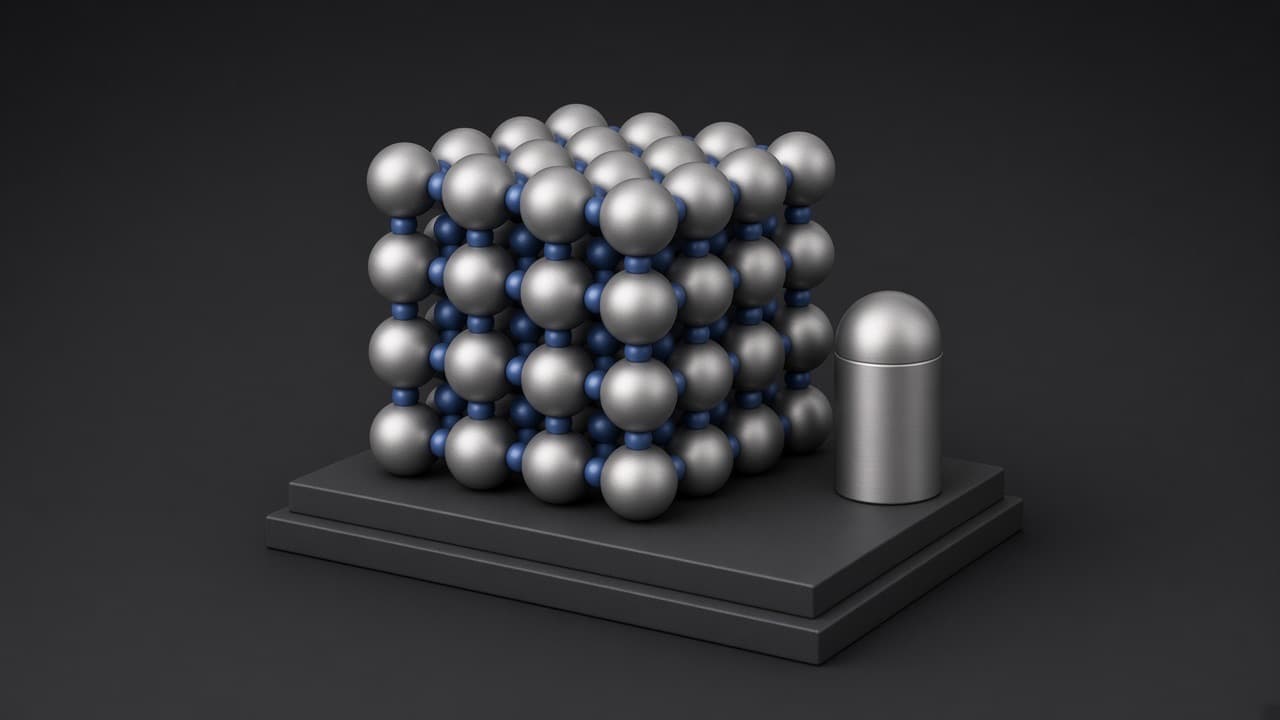
- Stationary storage
- Metal-hydride tanks
- Hydrogen supply for fuel cells
Why this domain matters to your work.
Metal hydrides store hydrogen by holding it inside a crystal, so a tank can keep it at low pressure and give it back when it is warmed or the pressure drops. That makes them a practical choice for stationary storage, metal-hydride tanks and hydrogen supply for fuel cells, where compactness and low pressure count for more than weight. The right hydride takes hydrogen up and releases it close to room temperature, at a pressure the rest of the system can work with.
Capacity and easy release work against each other. Magnesium hydride holds the most hydrogen by weight but binds it too tightly to let go near room temperature, while hydrides that release easily, such as LaNi₅ and its relatives, are heavy and depend on lanthanum and nickel. TiFe and the titanium–zirconium–manganese Laves hydrides cost less but need tuning to reach a useful plateau. Every change in composition shifts capacity, release temperature, metal cost and supply risk together, so they have to be weighed at once.
In a campaign, you specify the capacity, the temperature at which the hydride must give hydrogen back and the metals you can source and afford. You receive ranked AB₅, AB₂, AB, bcc and magnesium hydrides with estimated release temperature and pressure, capacity by weight and by volume, stability, metal cost and supply risk. Capacities are for the ideal hydride, not measured reversible capacities. Kinetics, activation, cycling, hysteresis, impurity tolerance and how the material behaves in a tank are not predicted and need testing.
The material families this domain searches.
Each family brings its own structures and chemistry to the search. A campaign can search one of them or compare several under the same targets.
AB₅ hydrides
LaNi₅ and its substitutions, tuned to release hydrogen near room temperature, chosen when easy release matters more than weight.
AB₂ Laves hydrides
Hydrides of the titanium–zirconium–manganese class, chosen for good capacity at moderate cost, with a release pressure that composition can tune.
AB hydrides
TiFe and its substitutions, made from low-cost, plentiful metals, chosen for large stationary stores where price matters most.
bcc solid-solution dihydrides
Vanadium and titanium alloys that hold two hydrogens per metal atom, chosen for more capacity than the classic intermetallic hydrides offer.
Magnesium hydrides
Magnesium-based hydrides with the highest capacity in the domain, chosen for capacity even though they hold hydrogen too tightly for easy release.
The properties a campaign can aim for.
Choose the properties that matter to your work. For each one, say whether a candidate must meet it or should push it as far as it goes, with cost and supply always in view.
- Release near room temperature
- Gravimetric capacity
- Volumetric capacity
- Metal cost
- Supply risk
Starting points for a campaign.
Each starting point sets up a campaign for a common goal in this domain. Begin from one and adjust its targets, or set your own from the start.
Near-ambient AB₅ hydrides
Suits tank designers who need release near room temperature, searching LaNi₅ substitutions whose release pressure plateau is tuned to it.
High-capacity magnesium hydrides
Suits teams that put capacity first, searching for solutes that loosen magnesium hydride’s hold on hydrogen while keeping its capacity.
Low-cost TiFe and Laves hydrides
Suits stationary storage projects, ranking iron- and manganese-based hydrides on cost, supply risk and release temperature.
Rare-earth-free hydrides
Suits teams avoiding lanthanum supply risk, searching every hydride family outside the lanthanum supply chain.
What you specify, what you receive and where the figures stop.
MS Lattice hands your lab a shortlist to make and test. Its figures are screening estimates and calculations, not measurements of the new material, and each domain says where they stop.
You specify
The capacity, the temperature at which it must give hydrogen back, and the metals you can source and afford.
You receive
Ranked AB₅, AB₂, AB, bcc and magnesium hydrides, with estimated release temperature and pressure, capacity by weight and by volume, stability, metal cost and supply risk.
Before you rely on it
Capacities are for the ideal hydride, not measured reversible capacities, and hydrogen positions are modelled, not measured. Kinetics, activation, cycling, hysteresis, impurity tolerance and tank behaviour are not predicted.
The same four modes work in every domain.
Search from your targets alone, improve a material your team already uses, or watch the engine reach known materials, with the targets as guides or sealed away, to see how well it searches.
Open Discovery
Choose it when you know what the material must do but have no starting structure.
Prototype-Guided Optimization
Choose it when you already have a good material and want to make it better.
Guided Rediscovery
Choose it when you want to watch the engine reach a material you already know.
Blind Rediscovery Benchmark
Choose it when you want to test whether the engine finds an answer it was never shown.
Every candidate arrives with its record.
Each candidate comes ranked against your targets, with its estimated properties and their uncertainty, the checks it passed and a structure file to export, ready for your lab.
Questions teams ask about this domain.
Have a materials target? Tell us what it must do.
Share the material domain, the properties you need and the limits the material must respect. We will show you how MS Lattice would approach it through Norck, from a ranked shortlist for your own lab all the way to finished parts.