

Implant alloys.
Closer to bone, without nickel or cobalt.
An implant alloys campaign screens titanium and zirconium alloys for stiffness closer to bone, keeping out the elements you will not accept. You can also rank candidates for MRI imaging, and you receive a shortlist for your own laboratory testing, not a statement of medical suitability.
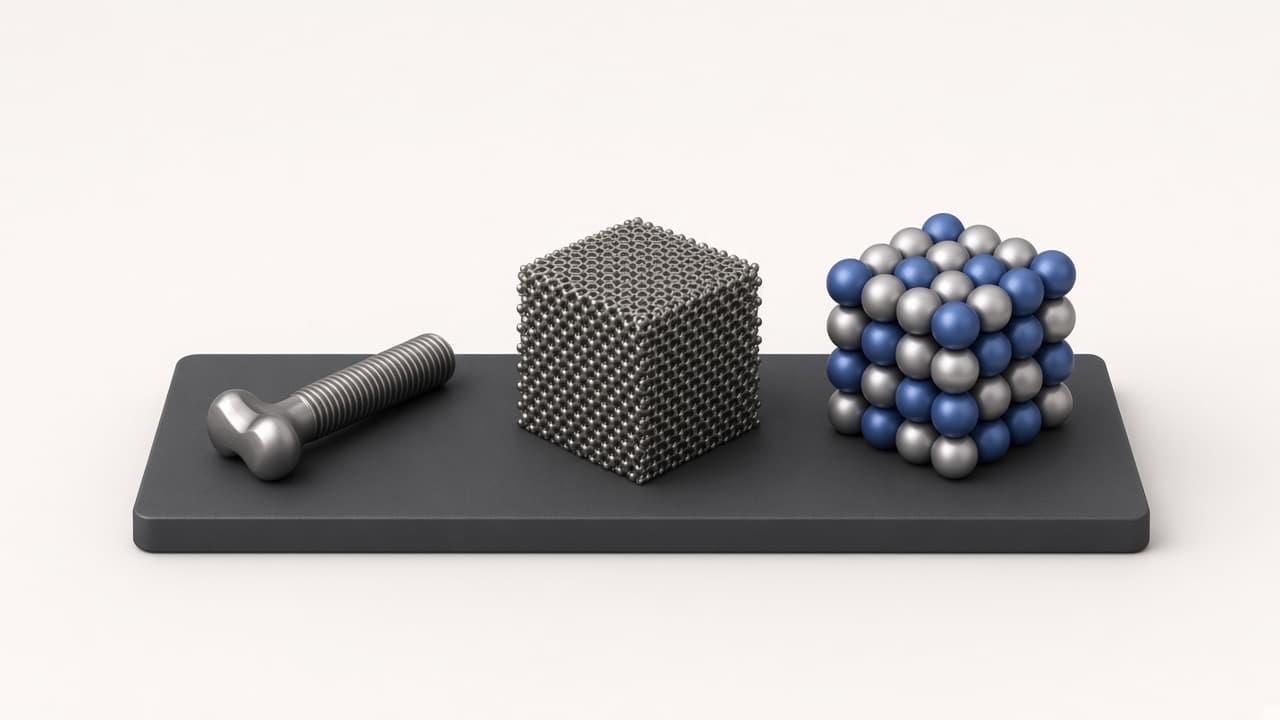
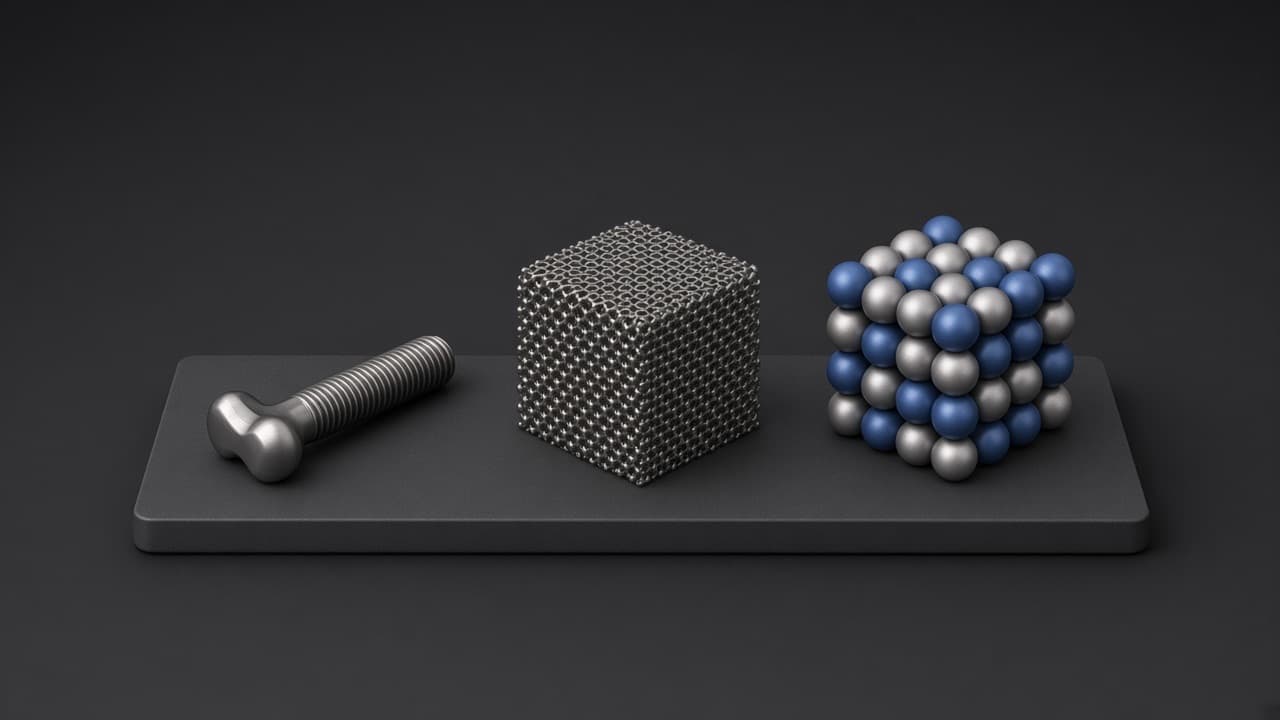
- Hip stems and spinal rods
- Dental and trauma implants
- Implants imaged by MRI
Why this domain matters to your work.
Implant alloys carry load inside the body for years, and the stiffness of the metal shapes how the bone around it is loaded. Titanium alloys go into hip stems, spinal rods, and dental and trauma implants, and zirconium alloys draw interest where an implant has to be imaged by MRI. A metal far stiffer than bone can take load away from the bone beside it, which is why designers keep looking for alloys with stiffness closer to bone and fewer of the elements they would rather leave out.
The targets pull in different directions. Lowering stiffness usually means a metastable β titanium, which needs enough stabilizing elements to keep its β phase, and the elements that do it best, such as niobium, tantalum and zirconium, are costly or hard to source. Many teams also want to avoid nickel, cobalt, aluminium or vanadium altogether. Zirconium alloys respond less to a magnetic field, which can reduce MRI artifact, but they bring their own cost and supply questions.
A campaign lets you specify the stiffness you want relative to bone, the elements you will not accept, the imaging the implant must tolerate and cost. You receive ranked titanium and zirconium alloys with estimated stiffness against bone, phase stability, a screen of the elements each contains, an indicative magnetic susceptibility and cost. The element screen is a classification, not a biological result. Corrosion, ion release, toxicity, bone integration, wear, fatigue and strength are not predicted and belong to laboratory testing, and nothing here is a statement of medical or regulatory suitability.
The material families this domain searches.
Each family brings its own structures and chemistry to the search. A campaign can search one of them or compare several under the same targets.
Low-modulus β titanium
β titanium alloys with stiffness nearer to bone and no aluminum, chosen so the implant takes less load away from the bone beside it.
Clinical α and α+β titanium
The established implant alloys, Ti–6Al–7Nb among them, and their close variants, chosen when you want to build on a familiar starting point.
Low-susceptibility zirconium
Zirconium alloys with a weaker magnetic response, chosen for implants that must cause less artifact when the patient is scanned by MRI.
The properties a campaign can aim for.
Choose the properties that matter to your work. For each one, say whether a candidate must meet it or should push it as far as it goes, with cost and supply always in view.
- Modulus matching to bone
- Element screen
- Solid-solution stability
- Magnetic susceptibility, indicative
- Ductility, indicative
- Cost and supply risk
Starting points for a campaign.
Each starting point sets up a campaign for a common goal in this domain. Begin from one and adjust its targets, or set your own from the start.
Low-modulus β titanium
Suits teams designing hip stems or spinal rods, seeking the lowest stiffness the β family reaches while its β phase is retained.
Low-susceptibility zirconium
Suits implants that will be imaged by MRI, ranking zirconium alloys by the lowest estimated magnetic susceptibility.
Clinical α+β titanium
Suits teams improving a current implant alloy, searching the established implant titanium and its variants that use less aluminum.
Low-cost implant alloys
Suits cost-conscious programs, searching every family without tantalum or hafnium, under a tight budget.
What you specify, what you receive and where the figures stop.
MS Lattice hands your lab a shortlist to make and test. Its figures are screening estimates and calculations, not measurements of the new material, and each domain says where they stop.
You specify
The stiffness you want relative to bone, the elements you will not accept, the imaging the implant must tolerate, and cost.
You receive
Ranked titanium and zirconium alloys, with estimated stiffness against bone, phase stability, a screen of the elements each contains, an indicative magnetic susceptibility for MRI, and cost.
Before you rely on it
Corrosion, ion release, toxicity, bone integration, wear, fatigue and strength are not predicted. The element screen is a classification, not a biological result, and nothing here is a statement of medical or regulatory suitability.
The same four modes work in every domain.
Search from your targets alone, improve a material your team already uses, or watch the engine reach known materials, with the targets as guides or sealed away, to see how well it searches.
Open Discovery
Choose it when you know what the material must do but have no starting structure.
Prototype-Guided Optimization
Choose it when you already have a good material and want to make it better.
Guided Rediscovery
Choose it when you want to watch the engine reach a material you already know.
Blind Rediscovery Benchmark
Choose it when you want to test whether the engine finds an answer it was never shown.
Every candidate arrives with its record.
Each candidate comes ranked against your targets, with its estimated properties and their uncertainty, the checks it passed and a structure file to export, ready for your lab.
Questions teams ask about this domain.
Have a materials target? Tell us what it must do.
Share the material domain, the properties you need and the limits the material must respect. We will show you how MS Lattice would approach it through Norck, from a ranked shortlist for your own lab all the way to finished parts.