

Nuclear fuels and core materials.
Fuels, claddings and steels for the core.
A nuclear fuels and core materials campaign screens candidate fuels, claddings and structural steels for the role you name. You receive a ranked shortlist for your own testing program, as screening only and never a licensing statement.
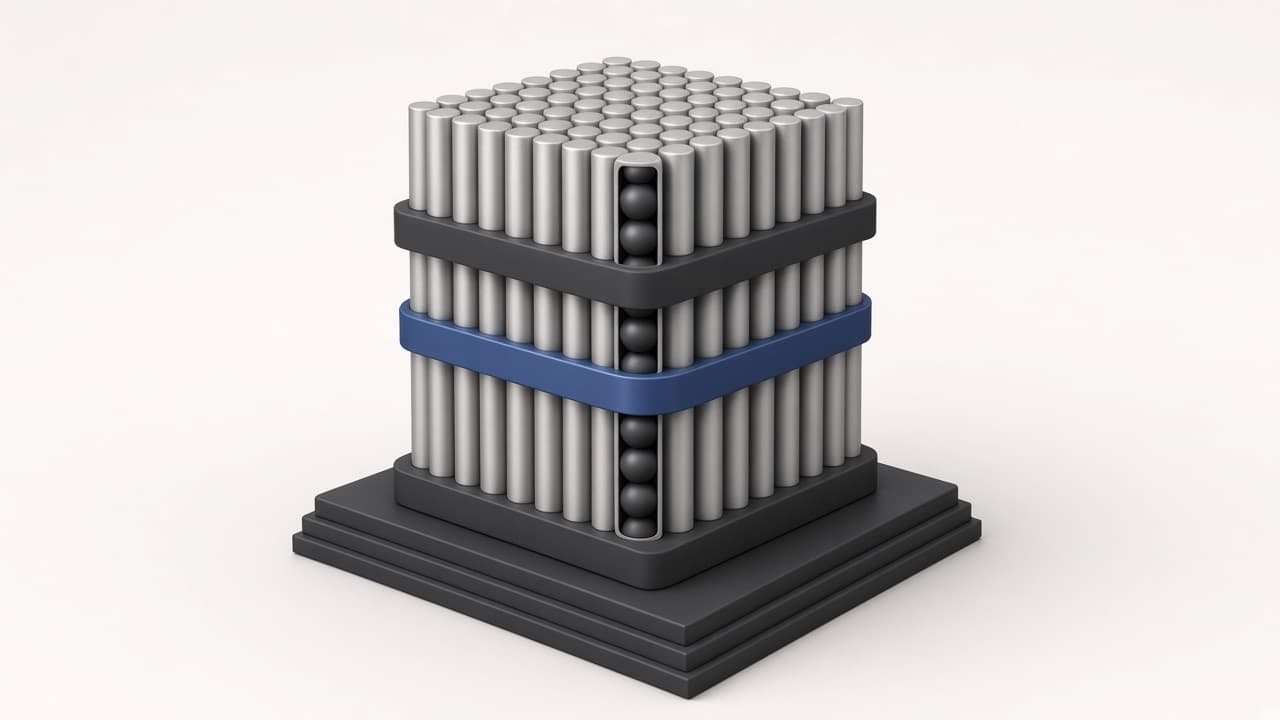
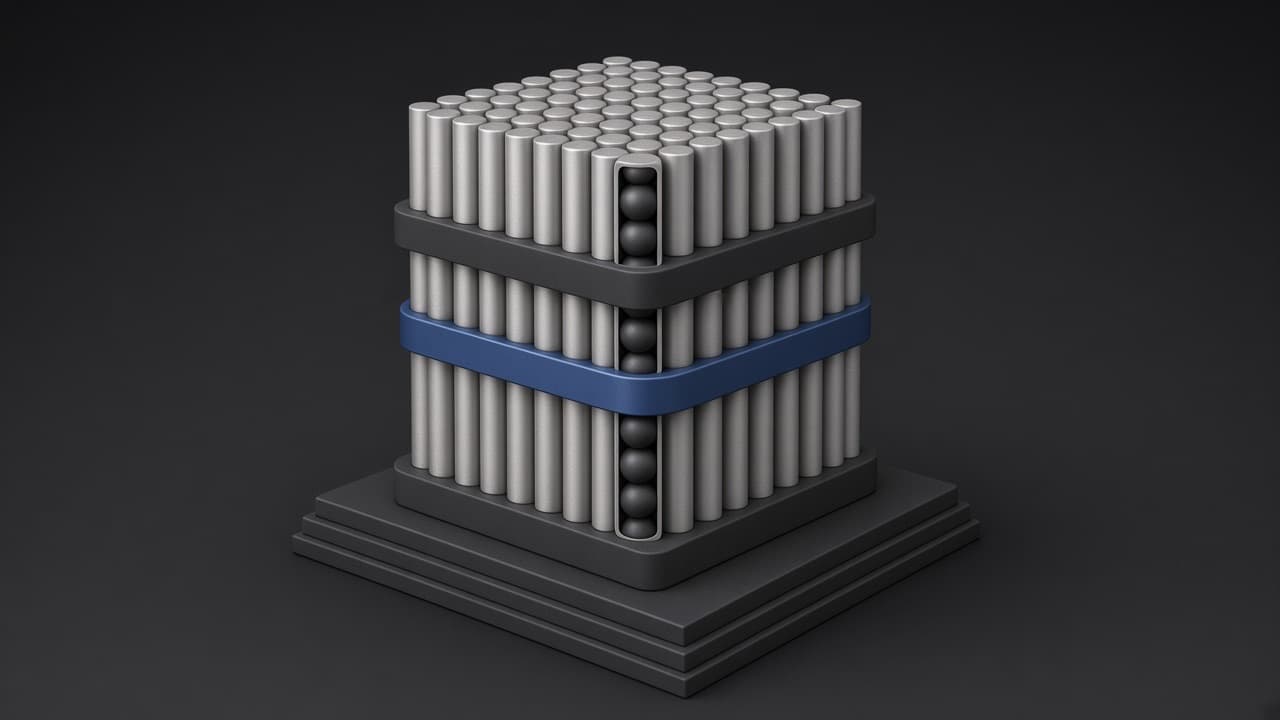
- Light-water reactors
- Fast and research reactors
- Fusion blankets
Why this domain matters to your work.
The materials in a fission core set how much energy a reactor can draw from its fuel and how much margin it keeps while doing so. Oxide fuels such as UO₂ and (U,Th)O₂ run most light-water reactors, nitride, carbide and metallic fuels pack in more heavy metal and carry heat out faster, zirconium claddings let neutrons pass, and reduced-activation ferritic steels hold the structure of fast reactors and fusion blankets. Each choice shapes the neutron budget, the thermal margin and what the plant must handle at end of life.
Every gain has a price. Denser, more conductive fuels improve thermal margin but raise their own fabrication and compatibility questions, while oxide fuel is well understood yet conducts heat poorly. Dopants that control grain growth or absorb neutrons change the neutron economy. Claddings and structural steels must absorb few neutrons, resist corrosion and keep activation low, and an element that helps one target often hurts another. The supply of specialty alloying elements and the long, costly irradiation testing every new composition needs add to the cost of each step.
A campaign lets your team name the role, fuel, cladding or structural steel, with the density, neutron budget, thermal margin and activation you can accept, and cost. You receive ranked oxide, nitride, carbide and metallic fuels, zirconium claddings and reduced-activation steels, with estimated neutron absorption, heavy-metal density, thermal margin, thermal conductivity at 1000 K, activation and cost, all for unirradiated material. This is screening only. No reactor physics is solved, irradiation behavior is not predicted, and acceptance of any material belongs to the operator and the regulator.
The material families this domain searches.
Each family brings its own structures and chemistry to the search. A campaign can search one of them or compare several under the same targets.
Oxide fuels
UO₂ and (U,Th)O₂ with dopants that absorb neutrons or control grain growth, chosen as the well-understood fuel of light-water reactors.
Nitride and carbide fuels
Uranium nitrides and carbides that are denser and more conductive than oxide, chosen to pack in more heavy metal and carry heat out faster.
Metallic fuels
U–Mo and U–Zr alloys held in the γ phase, chosen for high density and good heat transport in fast and research reactors.
Zirconium claddings
Zircaloy and the Zr–Nb alloys, chosen as fuel cladding because zirconium lets neutrons pass and resists corrosion in reactor water.
Reduced-activation ferritic steels
Structural steels designed to leave less long-lived activation, chosen for fast reactors and fusion blankets where end-of-life handling matters.
The properties a campaign can aim for.
Choose the properties that matter to your work. For each one, say whether a candidate must meet it or should push it as far as it goes, with cost and supply always in view.
- Neutron economy
- Heavy-metal density
- Thermal margin
- Heat transport at 1000 K
- Low activation
- Cost and supply risk
Starting points for a campaign.
Each starting point sets up a campaign for a common goal in this domain. Begin from one and adjust its targets, or set your own from the start.
Light-water-reactor oxide fuels
Suits light-water-reactor fuel teams, searching doped UO₂ and (U,Th)O₂ for better neutron economy and thermal margin.
High-conductivity fuels
Suits teams seeking more thermal margin, ranking nitride, carbide and metallic fuels on heat transport and heavy-metal density.
Low-absorption zirconium claddings
Suits cladding developers for thermal reactors, searching for zirconium alloys that absorb as few neutrons as possible.
Reduced-activation structural steels
Suits fusion-blanket and fast-reactor programs, ranking steels on low activation, heat transport and cost.
What you specify, what you receive and where the figures stop.
MS Lattice hands your lab a shortlist to make and test. Its figures are screening estimates and calculations, not measurements of the new material, and each domain says where they stop.
You specify
The role (fuel, cladding or structural steel), the density, neutron budget, thermal margin and activation you can accept, and cost.
You receive
Ranked oxide, nitride, carbide and metallic fuels, zirconium claddings and reduced-activation steels, with estimated neutron absorption, heavy-metal density, thermal margin, thermal conductivity at 1000 K, activation and cost, all for unirradiated material.
Before you rely on it
No reactor physics is solved. Burnup, fission-gas release, swelling, irradiation effects, coolant corrosion and criticality are not predicted, and nothing here is a licensing statement.
The same four modes work in every domain.
Search from your targets alone, improve a material your team already uses, or watch the engine reach known materials, with the targets as guides or sealed away, to see how well it searches.
Open Discovery
Choose it when you know what the material must do but have no starting structure.
Prototype-Guided Optimization
Choose it when you already have a good material and want to make it better.
Guided Rediscovery
Choose it when you want to watch the engine reach a material you already know.
Blind Rediscovery Benchmark
Choose it when you want to test whether the engine finds an answer it was never shown.
Every candidate arrives with its record.
Each candidate comes ranked against your targets, with its estimated properties and their uncertainty, the checks it passed and a structure file to export, ready for your lab.
Questions teams ask about this domain.
Have a materials target? Tell us what it must do.
Share the material domain, the properties you need and the limits the material must respect. We will show you how MS Lattice would approach it through Norck, from a ranked shortlist for your own lab all the way to finished parts.